
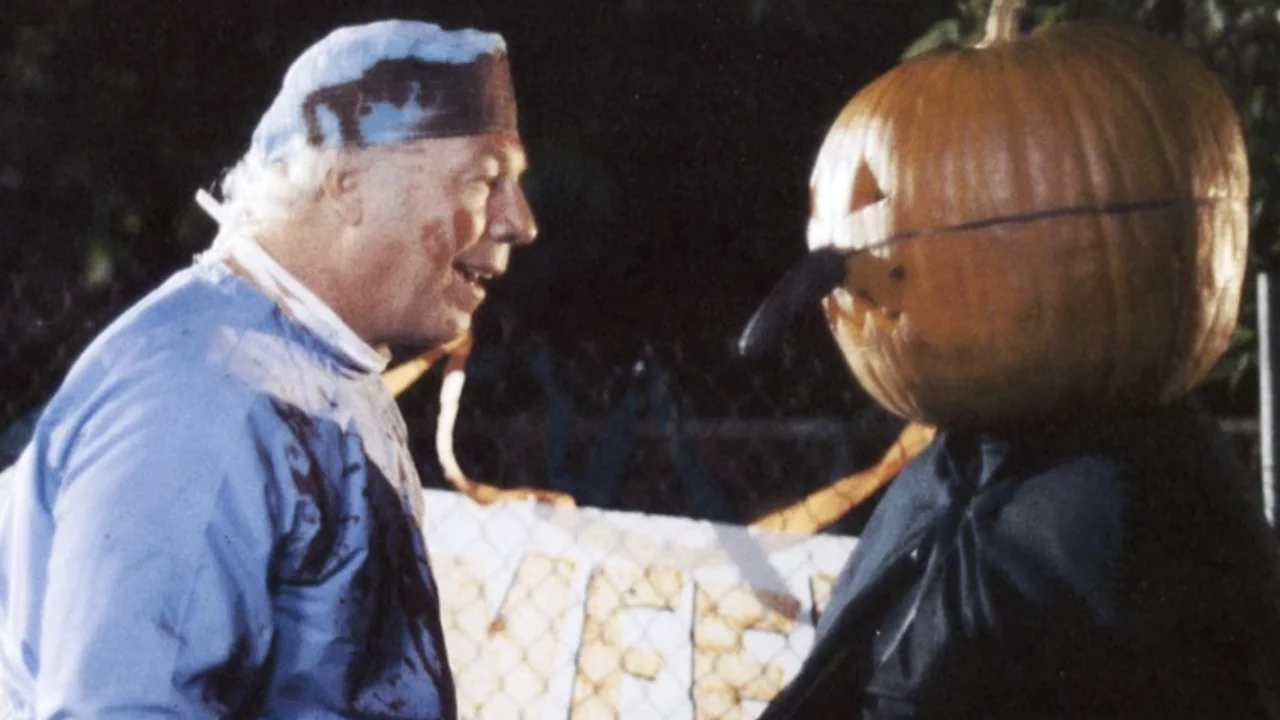
Long before Ghostface started hassling teenagers about their favorite slasher flicks in Scream, and Scary Movie turned horror parody into a blockbuster franchise, a different kind of pumpkin-headed maniac was terrorizing high school students with gardening equipment.
His name was the Lawnmower Killer, and his movie was Wacko, a 1982 genre spoof that deserves a little more attention every Halloween as we get further away from its unprecedented release, and it completely fades from the collective pop consciousness.
A Pumpkin-Headed Killer Takes Aim at the Slasher Craze
Directed by Greydon Clark, Wacko arrived during the slasher boom, when masked killers and imperiled teenagers were practically an industry of their own. Rather than play the formula straight, Clark and his team of writers decided to turn the whole thing into one big joke. The result was an Airplane!-style comedy aimed squarely at the horror movies audiences were flocking to see at that time.
The setup sounds like somebody challenged a screenwriter to cram as many Halloween clichés as possible into one movie. Thirteen years after a pumpkin-masked killer murdered her older sister, Mary Graves (Julia Duffy) is preparing for her own high school Halloween Pumpkin Prom. She has good reason to be nervous. The killer was never caught, and an inmate has escaped from a local mental hospital just as the anniversary of the murders approaches.
Enter Dick Harbinger (Joe Don Baker), a detective who has spent years trying to crack the case. He’s determined to catch the killer before another Halloween dance becomes a bloodbath, although the film’s commitment to absurdity makes it difficult to take much of anything seriously. The school is Alfred Hitchcock High, Mary’s boyfriend is named Norman Bates, and the movie has no interest in leaving a perfectly good horror reference alone when it can squeeze another gag out of it. That almost sounds like Scream just told through a much more heightened lens.
Wacko wasn’t content to make fun of slashers. It threw in nods to Psycho and The Exorcist, among other horror favorites, while its Halloween dance gave the filmmakers an excuse to send up the teen comedies popular at the time. The jokes come fast, with varying degrees of success. Some are gloriously ridiculous. Others have the sort of juvenile sensibility that makes you wonder whether the writers were competing to see what they could get away with. And apparently, back in Hollywood’s coke heyday, they could get away with a lot.
The cast is a big part of the film’s peculiar appeal. Baker, best known for playing tough guys, gets to send up the hard-boiled detective, while George Kennedy and Stella Stevens play Mary’s parents, whose first names are Mr. Doctor and Mrs. Doctor. Kennedy’s character also has a particularly uncomfortable running gag involving his habit of spying on his own daughter. This is very much an early-’80s comedy, and not every joke has aged gracefully.
Then there’s Andrew Dice Clay, credited as Andrew Clay, playing high school heartthrob Tony Schlongini in his first feature film role. E.G. Daily, credited as Elizabeth Daily, also appears as Bambi. Daily would go on to become familiar to generations of audiences as the voice of Tommy Pickles on Rugrats, among numerous other voice roles. But I’ll always love her most as Dottie in Pee-wee’s Big Adventure. Seeing these performers in a movie this gloriously strange is part of the fun.
Before Scream, There Was Wacko and Pandemonium
It would be tempting to call Wacko a forgotten predecessor to Scream and Scary Movie, but the comparison needs a little perspective. John Carpenter’s Halloween helped establish the slasher conventions that the film mocks, while Scream later built its own identity around characters who understood horror movie rules. Scary Movie took the parody approach to a new generation of audiences. Wacko was already making a mess of slasher conventions in 1982, years before either film arrived.
That doesn’t mean Wes Craven or the Scary Movie filmmakers borrowed from Clark’s movie. There’s no need to invent a direct connection to appreciate the chronology. Wacko was taking aim at the genre while the slasher craze was still in full swing, rather than looking back at it from a distance.
The film’s reputation has remained decidedly mixed. Its scattershot humor and adolescent jokes aren’t for everyone, and it never became a household name alongside the horror comedies that followed. Still, Wacko has found a second life among fans of strange, overlooked genre movies. Boutique label Vinegar Syndrome gave the film a new 4K scan from its original 35mm camera negative for its Blu-ray release, making it easier for curious horror fans to revisit the movie in a much better presentation than its old VHS incarnation.
There’s something fitting about Wacko surviving as a Halloween oddity. It has a pumpkin-headed killer, after all. The movie may not land every joke, but it certainly doesn’t lack nerve. If your October horror watchlist has room for something outside the usual rotation, Wacko is worth tracking down. Just don’t expect the Lawnmower Killer to be as subtle as Ghostface.
Now, I know some of you are stopping me there and saying, “Didn’t Pandemonium get there first?”
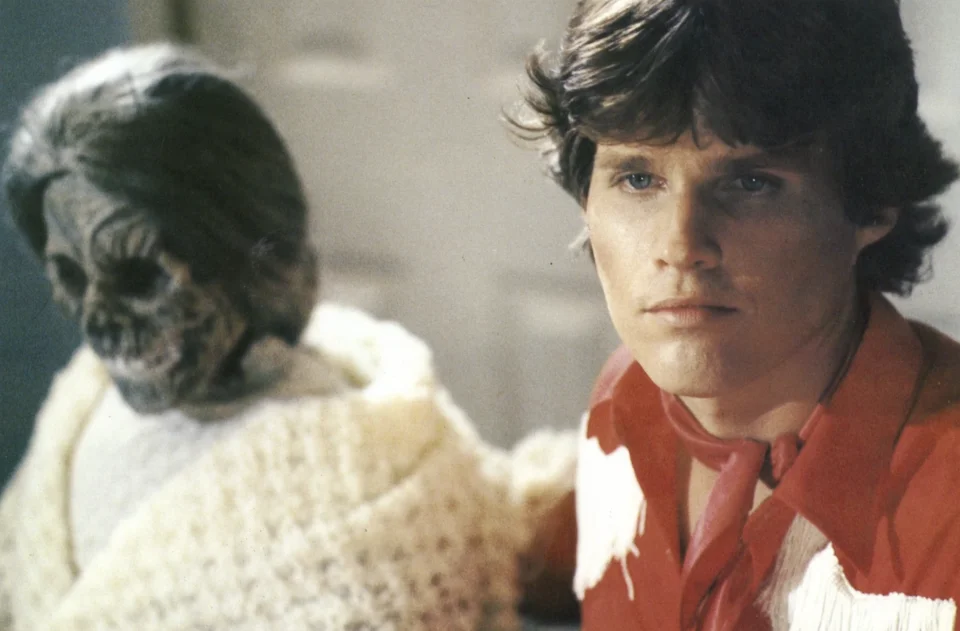
This is very much true, but it didn’t take place on Halloween, and it didn’t have a pumpkin-faced killer or a pumpkin-themed fall dance. Aside from that? You are right. Wacko wasn’t the only horror comedy struggling to make audiences laugh at the slasher craze. Alfred Sole’s Pandemonium actually reached theaters first, opening on April 2, 1982, through MGM/UA. Wacko followed with a limited regional release in May before receiving a wider U.S. theatrical release in January 1983. Both movies assembled casts packed with familiar faces, hoping that a barrage of horror references and broad comedy would be enough to sell the joke. Neither became a hit, and both eventually found a second life among collectors and fans of oddball genre cinema, especially on pay cable channels of the time like Showtime and The Movie Channel (that’s where I first saw them).
The timing is interesting. Following the success of Airplane! in 1980, movie studios and independent filmmakers were eager to apply rapid-fire spoof comedy to just about anything audiences recognized. Horror was an obvious target, with Student Bodies, Saturday the 14th, National Lampoon’s Class Reunion, Pandemonium, and Wacko all taking swings at familiar genre conventions around the same period. The problem was that not every parody landed its punches. While Scream would later find a more enduring way to poke fun at slasher rules, these early-’80s comedies largely slipped out of the mainstream conversation. Today, films like Wacko and Pandemonium offer a strange little snapshot of a moment when Hollywood couldn’t resist making fun of the very horror craze it was busy exploiting.
I think the coolest connection between Wacko and Pandemonium is that E.G. Daily appeared in one, while her iconic Pee-wee co-star Paul Reubens took on one of his first lead roles in the other. That’s the kind of kitsch that Paul himself loved.