
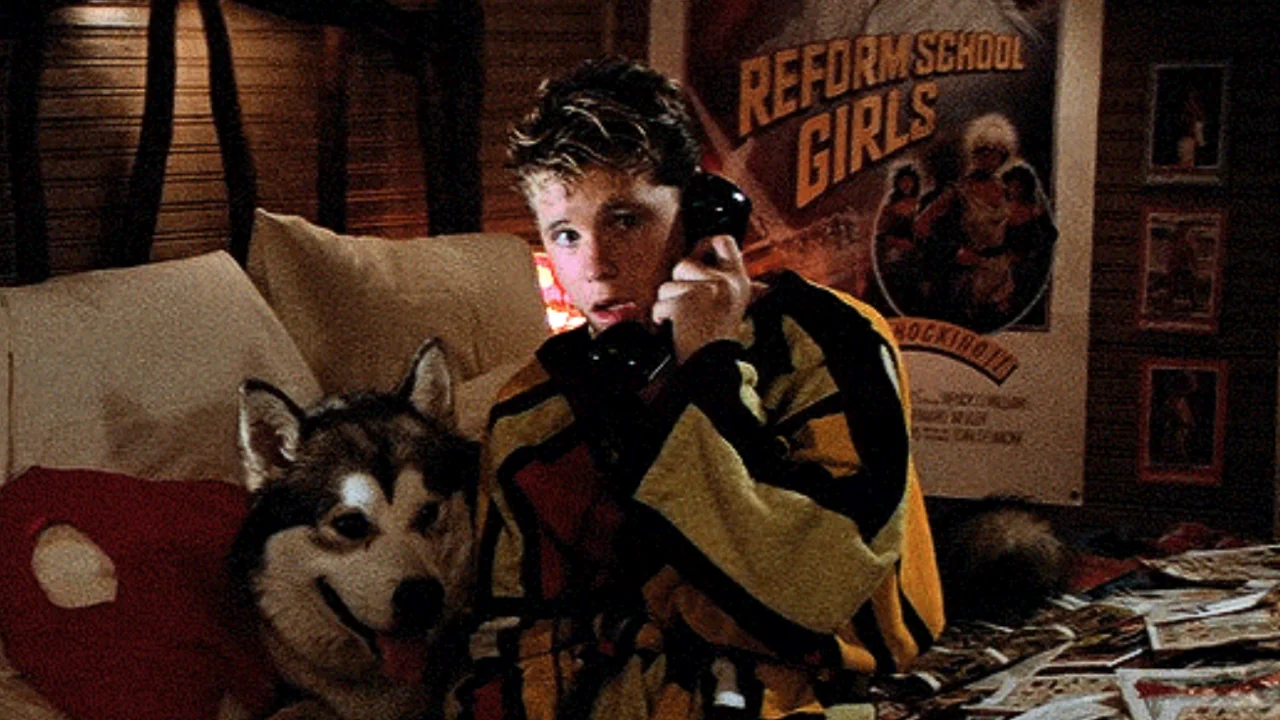
How many times did you watch The Lost Boys before you finally decided it was time to see Reform School Girls? For me? It wasn’t until earlier this year, when I went to see Joel Schumacher’s vampire classic on the big screen, and was once again caught off guard by the one-sheet for Reform School Girls hanging very prominently on Sam’s bedroom wall.
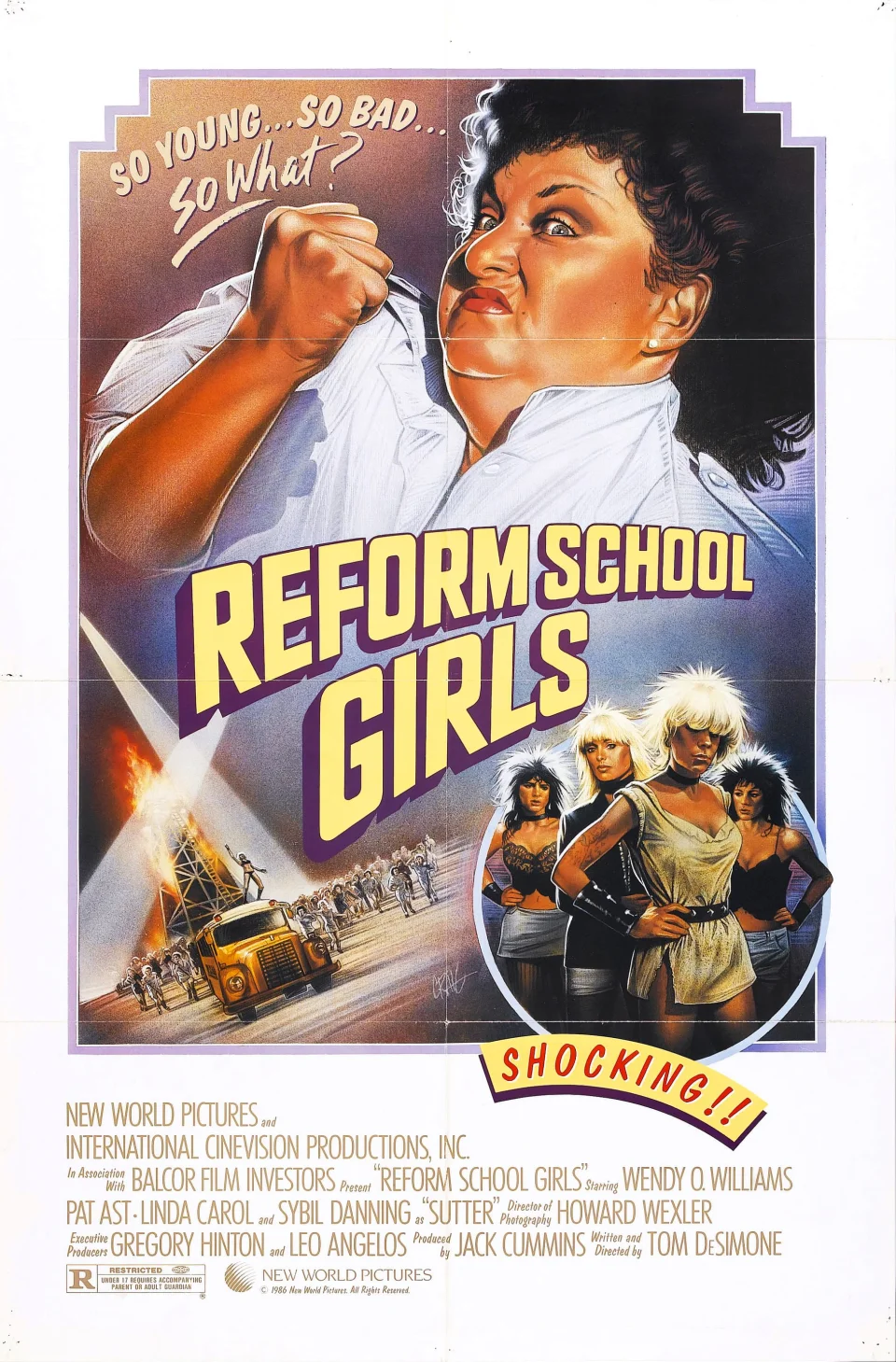
It’s a beautiful poster, with striking artwork from illustrator Craig Nelson. This was definitely the kind of movie I hungered for in my youth. I’m a huge fan of the “WIP” subgenre (which stands for Women In Prison). But for some reason, Reform School Girls always eluded me.
It’s not like I never noticed the poster before. I remember wondering why Sam, played by Corey Haim, had chosen that as one of three movies to decorate his bedroom with. You’ll notice he also has an unsanctioned poster of Molly Ringwald from The Breakfast Club on prominent display. And most notoriously, he has a K-Mart wall poster of Rob Lowe released to retail around the time St. Elmo’s Fire was in theaters.
Many fans believe the Rob Lowe poster was used by Joel Schumacher to point toward Sam’s burgeoning sexuality as a 15-year-old, but Joel always denied those theories, most famously in his audio commentary for The Lost Boys DVD. He claims it was there because of his friendship with Lowe, and an Easter egg for his own movie. If you don’t know, he directed St. Elmo’s Fire two years before diving into the bloodthirsty vamps of Santa Carla.
Fair enough, fans can read into the subtext however they choose. According to Joel, he saw the Rob Lowe poster somewhere out in the wild, thought it was “shameless,” and bought it for his own collection. As a laugh, and a joke to jab his pal Lowe, he made sure to stick it on prominent view in Sam’s room.
The Rob Lowe poster was one any fan could buy at the local Fred Meyer. But that giant Molly Ringwald poster had to be made by the art director. It’s a one of a kind, and probably got thrown in the trash after production ended. So don’t go scouring eBay for one.
Sam loved Molly and Rob equally. And this blown-up still from John Hughes’ 1985 classic was placed on the wall to show both Sam and Schumacher’s Brat Pack fandom. You can see rolled posters in Sam’s belongings when they first get to his grandpa’s house. So no, these didn’t belong to Gramps before Sam took over one of the upstairs rooms in his house of taxidermy.
That Iconic Reform School Girls Poster
That brings us to that iconic Reform School Girls poster.
Reform School Girls has a completely different connotation to film history, and the reason why Schumacher chose to decorate Sam’s bedroom wall with it. The campy 1986 grindhouse action comedy was directed by Tom DeSimone, who recently passed away. He has one of the more colorful backstories in Hollywood history. And with that poster hanging so prominently on Sam’s wall, Joel wasn’t just paying tribute to an awesome flick. He was also honoring the storied career of a pioneer in American gay liberation cinema.
Tom DeSimone had one of the more unusual careers running alongside the midnight cult circuit. He went from making adult-themed films during the genre’s so-called Golden Age to directing the kind of gloriously over-the-top B-movie trashterpieces that genre fans still celebrate today.
His career is a reminder that Hollywood’s exploitation era was full of filmmakers who took unconventional routes to the movies we now cherish. And Joel absolutely brought some of that rebel spirit into The Lost Boys, to make a classic that salted the proceedings with the glorious camp that had come before it.
DeSimone studied filmmaking at Emerson College in Boston, earning a bachelor’s degree in directing before heading to UCLA for a master’s degree in Motion Picture Production. I always thought Sam’s last name, Emerson, was a nod to the cheap TV I watched The Lost Boys on all through high school. But maybe Sam and Michael’s surname is also a sly wink at DeSimone and his educational background.
Tom’s first feature-film experience came with 1968’s Terror in the Jungle, an ultra-low-budget adventure production that left him dissatisfied enough with the producers to walk away, even though his name remained attached to the finished film.
He soon found a different path in the burgeoning adult-film business, establishing his own production company and frequently working under the name Lancer Brooks. DeSimone became part of a period when some after-hours filmmakers were pushing beyond short, loosely connected scenes toward feature-length stories that featured realistic characters and actual dramatic ambitions.
His early work includes 1970’s The Collection and 1972’s Prison Girls, the latter remembered as an early milestone in adult 3D cinema.
Then came one of the strangest bridges between his adult-film career and mainstream cult flicks: 1977’s Chatterbox!, a musical comedy about a woman whose vagina talks. Yes, that is the actual premise. Released by American International Pictures, the film helped introduce DeSimone to a wider audience and demonstrated that he was perfectly comfortable working in territory most directors wouldn’t touch with a ten-foot pole.
By the 1980s, DeSimone was making films that became staples for fans of horror and exploitation cinema. He directed 1981’s Hell Night, a slasher starring Linda Blair, followed by 1982’s The Concrete Jungle, another entry in the WIP subgenre. His filmography also included the trilogy ending sequel Angel III: The Final Chapter from 1988.
For many cult-movie fans, 1986’s Reform School Girls remains one of his most distinctive calling cards.
Starring punk-rock icon Wendy O. Williams, Reform School Girls takes the women-in-prison formula and pushes it into outrageous, deliberately exaggerated territory. DeSimone understood the appeal of a genre built on rebellion. He relished languishing in truly bad behavior. His characters were purposely larger-than-life. Yet he gave the material a stylized, satirical edge. It’s the sort of movie that knows exactly what kind of trouble it wants to cause.
Sam Emerson is the embodiment of this aesthetic in his fashion choices and his ribald attitude when it comes to staking vampires. He’s apprehensive about his brother’s transformation at first. Then almost gleefully joins a pair of vampire hunters for what is, below the surface, a very DeSimone-coded blitz of a final showdown between the humans and the bloodsuckers.
Two Very Different Cult Movies With a Common Spirit
On the surface, Reform School Girls and The Lost Boys don’t look like they belong on the same rack at Nordstrom. But they both uphold the same kind of jubilant spirit. At first glance, they seem like they belong on completely different ends of the 1980s cult-movie shelf. One is a supernatural vampire horror film about teenagers getting mixed up with the wrong crowd. The other is a women-in-prison exploitation picture packed with abusive authority figures and punk-rock attitude.
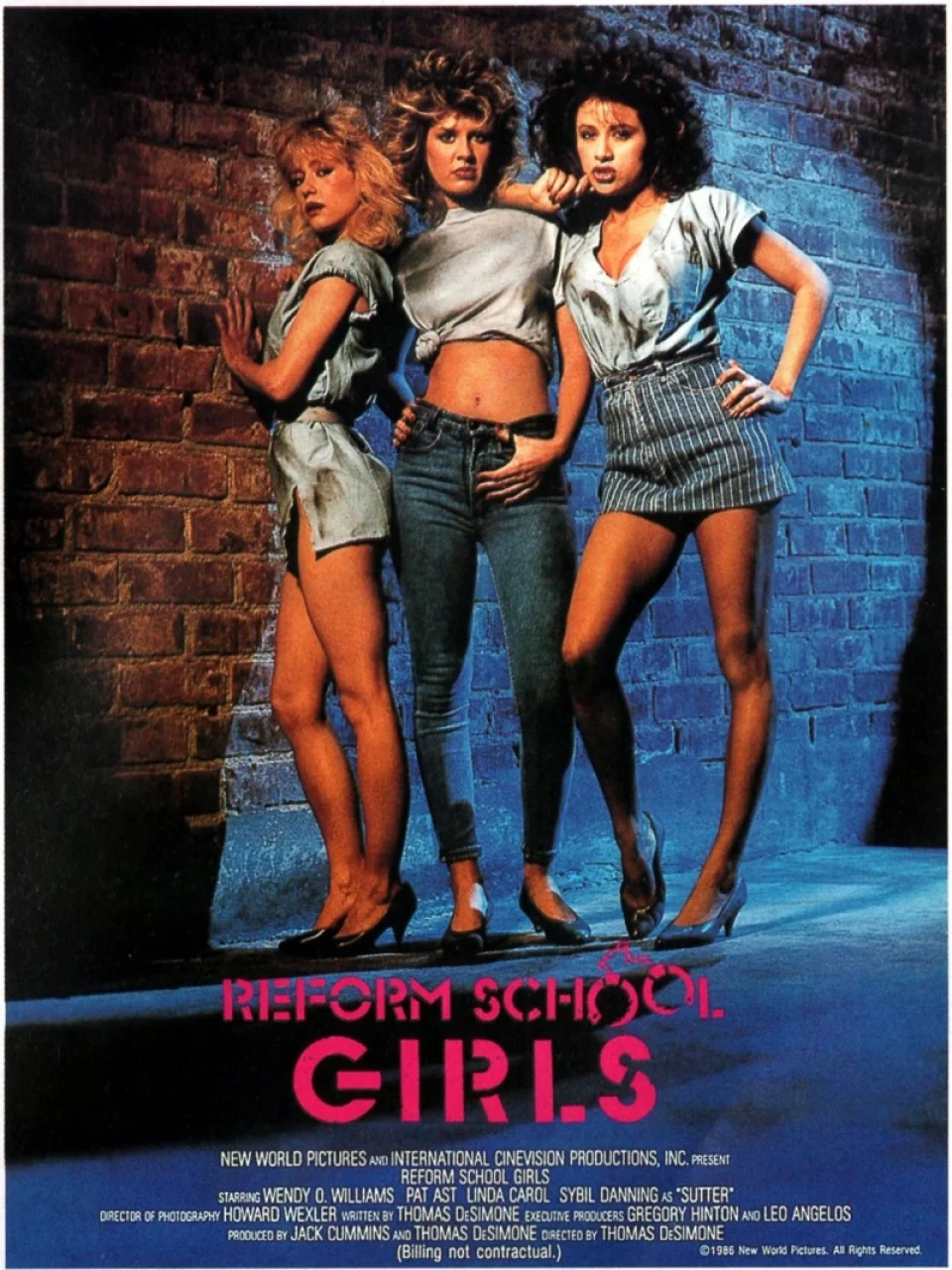
But look past the wildly different levels of sleaze, and these two movies have more in common than you might expect.
Both films tap into the decade’s youth counterculture, using rebellious outsiders and corrupt authority figures to explore what happens when young people are left vulnerable to toxic subcultures. They approach the subject from different directions, but each turns the promise of belonging into something dangerous.
In The Lost Boys, David and his vampire family offer Michael the kind of freedom that looks irresistible when you’re young. Leather jackets, dirt bikes, glam-rock swagger, and a lifestyle built around staying up all night make the gang seem like an escape from ordinary life. But there’s a nasty catch. Max and David’s operation functions as a predatory alternative family, drawing vulnerable teenagers into a world where the price of fitting in could be their humanity. The invitation to “Sleep all day. Party all night. Never grow old. Never die” sounds pretty great until you realize what you’re signing up for.
Reform School Girls presents a more openly brutal version of that same trap. Warden Sutter and Head Matron Edna preside over a reformatory where cruelty and intimidation are dressed up as discipline and rehabilitation. Instead of vampires promising eternal youth, the institution offers the young women a system that claims to reform them while subjecting them to abuse. The authority figures are supposed to protect and correct the inmates, but their regime is part of the problem.
Then there’s the punk-rock rebellion running through both films. In The Lost Boys, the vampire gang’s glam-rock attitude gives its members an alluring outlaw image. They look like people who have figured out how to live without rules, which is precisely why Michael finds them so tempting. In Reform School Girls, Wendy O. Williams brings that confrontational energy to Charlie, whose snot-rock refusal to behave makes her a walking rejection of authority. Charlie’s punk identity is raw and explosive, turning the film’s rebellion into something you can practically hear through the screen.
Looking rebellious and escaping a corrupt system are two very different things. Both movies understand that the freedom offered by a dangerous group can become another form of control.
That brings us to innocence, or what remains of it after these characters have been pulled into worlds that threaten to change them forever. Michael and Star in The Lost Boys struggle against the possibility of becoming something monstrous. Their predicament is more than a matter of surviving a vampire attack. They must resist the pull of a subculture that could permanently alter who they are. In Reform School Girls, Jenny faces a different kind of fight. She must survive the reformatory’s corrupting influence without losing her humanity in a place where cruelty is treated as normal.
Both films also have a lot to say about the difference between finding a family and being forced to belong. The vampire pack in The Lost Boys offers Michael companionship and a ready-made identity, but acceptance comes with a demand for conformity. You can join the gang, but you have to play by its rules. The inmates in Reform School Girls face their own version of that pressure. New arrivals must navigate the prison’s cliques, deciding whether to submit to bullies or find others willing to stand up and fight back. In both cases, belonging can offer protection, but it can also become a tool for coercion.
There’s another connection hiding beneath the leather jackets and institutional uniforms: the breakdown of the traditional family. In The Lost Boys, divorce and absent fathers leave the teenage characters vulnerable as they try to find their place in a changing family structure. That instability helps create an opening for the vampire gang to offer Michael an alternative home. In Reform School Girls, the young women have been failed in a different way. Broken homes and wider societal abandonment leave them in the hands of a state reformatory that is supposed to provide correction but instead exposes them to another form of harm.
Neither film treats the search for belonging as a simple teenage phase. The need to fit in can be powerful enough to pull young people toward groups that exploit their vulnerabilities, particularly when the adults and institutions that should protect them have already failed.
Ultimately, The Lost Boys and Reform School Girls turn the anxieties of 1980s youth culture into dark, highly stylized cautionary tales. One filters its fears through vampires and rock-and-roll excess. The other delivers them through prison walls and punk defiance. Both show how easily the promise of freedom can become another kind of captivity when teenagers are left to fend for themselves among predatory people.
They may have very different ideas about what makes a good cult movie, but these two mid-1980s films share a common suspicion: sometimes the people offering you a place to belong are the very people you need to escape.
Tom DeSimone’s Unconventional Hollywood Path
Joel Schumacher never publicly mentioned Tom DeSimone or his work as an influence. But we can see it hanging right there in Sam Emerson’s bedroom. A winking nod to the paths that Tom blazed as an adult filmmaker who worked his way into a more mainstream river of entertainment, even if his movies did pretty much only hang out under the cult banner at the local video store. He was a VHS maven, Joel picked up the baton and ran it right into more mainstream blockbuster box office fare like Flatliners and the Batman franchise.
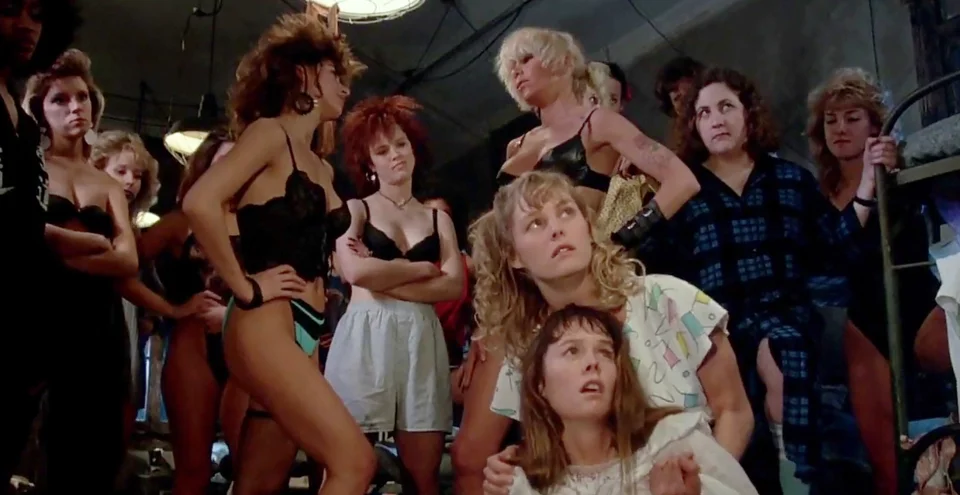
Tom DeSimone was working concurrently alongside Joel’s fire path through a more pop-culture environment stream. Tom was more of a peer than a mentor. As the 1980s gave way to the 1990s, DeSimone moved increasingly into television, directing episodes of genre shows including Freddy’s Nightmares, Swamp Thing, and Dark Justice. He also spent a year in Mexico directing all 60 episodes of the telenovela Acapulco Bay, a remarkable assignment that speaks to the sheer range of work he took on throughout his career.
DeSimone’s path from adult cinema to exploitation and television wasn’t a conventional Hollywood journey, but conventional was never really the point. His films occupy a particular corner of cinema history where low budgets, strange premises, and unrestrained personalities have turned profit as cult favorites.
With Reform School Girls, he gave fans more reason to celebrate the wonderfully unruly side of genre filmmaking.
Tom DeSimone passed away on October 17, 2026, at the age of 87. The Lost Boys came out in ’87. There are consequences everywhere. As an artist, DeSimone left us with some intriguing stretches of film. If you’re a fan of The Lost Boys, I implore you to seek out Reform School Girls. It celebrates its 40th anniversary this year, and it deserves a long life as your next cult favorite. Trust me, you won’t be disappointed. And if you’re a huge Linda Blair fan, like me, check out DeSimone’s Hell Night next. He’s also an uncredited director on her Savage Streets, which I just love to death.
In the immortal words of Edna…
“In this house, I am God. And you are all just miserable little sinners waiting for retribution.”