
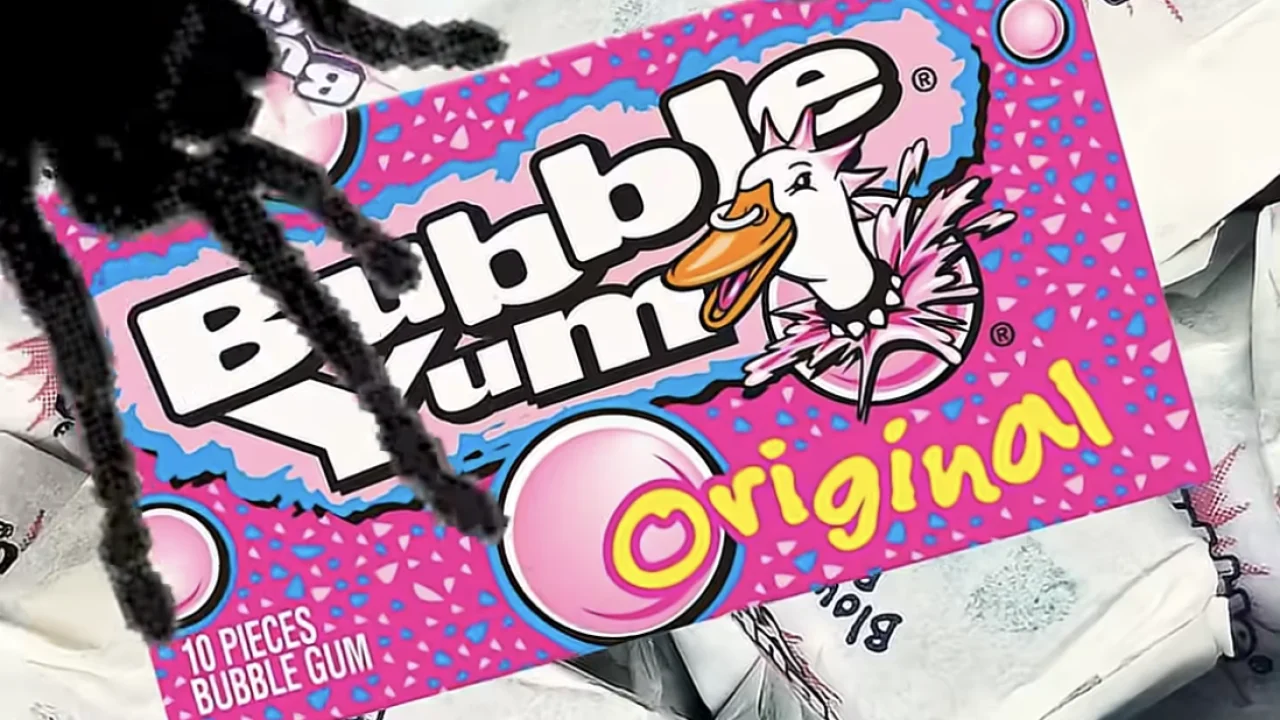
If you grew up in the late 1970s or early 1980s, there’s a good chance you heard something pretty disturbing about Bubble Yum bubble gum.
According to a rumor that spread through schoolyards across America, the popular chewing gum contained spider eggs. Some kids insisted they could actually feel the eggs crunching between their teeth, while others claimed that chewing the gum could cause spiders to hatch inside your mouth.
None of it was true, but the story became so widespread that Bubble Yum’s parent company had to launch a public campaign to convince customers that its gum wasn’t filled with baby spiders.
How did one of America’s most popular bubble gums become the subject of one of the strangest candy rumors of the 20th century?
Bubble Yum was introduced by Life Savers in 1975 and quickly became a sensation. Unlike the harder bubble gums that dominated the market at the time, Bubble Yum was unusually soft and easy to chew straight out of the package. It also produced enormous bubbles, making it especially popular with kids.
That unusual texture may have helped fuel the rumor. Bubble Yum was marketed as the first soft bubble gum, and its consistency was noticeably different from familiar brands like Bazooka and Double Bubble. For children who had never experienced gum that soft before, the idea that something unusual might be hiding in the ingredients apparently wasn’t too difficult to believe.
By 1977, the spider egg story was spreading rapidly. Playground gossip claimed that Bubble Yum contained spider eggs to make it softer, with some versions of the rumor specifying tarantula eggs. Other variations suggested the eggs could hatch after being swallowed, leading to increasingly elaborate stories about spiders emerging from people’s mouths or noses.
The rumor spread long before social media, smartphones or the internet made misinformation instantaneous. Kids carried the story from school to school, passing it along as something they had supposedly heard from a friend, sibling or someone who knew a person working at the gum factory. And people believed it.
Bubble Yum’s sales reportedly suffered as the story gained traction, prompting Life Savers to take the unusual step of addressing the rumor directly in newspaper advertisements.
In 1977, the company ran full-page ads denying that Bubble Yum contained spider eggs or any other insect ingredients. The advertisements attempted to reassure parents and children that the gum was manufactured using ordinary ingredients and that the entire story was nothing more than a rumor. The fact that a major candy manufacturer had to publicly deny putting spider eggs into chewing gum says plenty about how seriously the story was being taken.
Where did the Bubble Yum Spider Eggs rumor actually begin?
That’s the part nobody has ever definitively established. Urban legend researchers have documented the Bubble Yum story for decades, but there’s no confirmed original source or individual responsible for starting it.
Some accounts suggest the rumor began as an attempt to explain the gum’s unusually soft texture. Others have speculated that competing candy companies or mischievous schoolchildren may have helped spread the story, although there’s no solid evidence that a rival manufacturer deliberately created the hoax.
The rumor also followed a familiar pattern seen in other food-related urban legends. An unfamiliar ingredient or manufacturing process becomes the subject of speculation, someone invents a disturbing explanation, and the story spreads because it’s just believable enough to make people uncomfortable.
Bubble Yum survived the controversy and remained a recognizable candy brand long after the spider egg panic faded. The gum continued appearing in stores throughout the following decades, while the story became part of the folklore surrounding popular snacks of the 1970s.
Today, the Bubble Yum spider egg rumor is remembered as one of the classic playground urban legends, alongside stories about swallowed gum remaining in your stomach for seven years and other questionable warnings passed between generations of kids.
For the record, Bubble Yum never contained spider eggs. The gum’s soft texture came from its formulation, not anything involving spiders, tarantulas or their offspring. But if you remember hearing the rumor when you were a kid, you probably also remember that moment of hesitation before putting another piece in your mouth.