
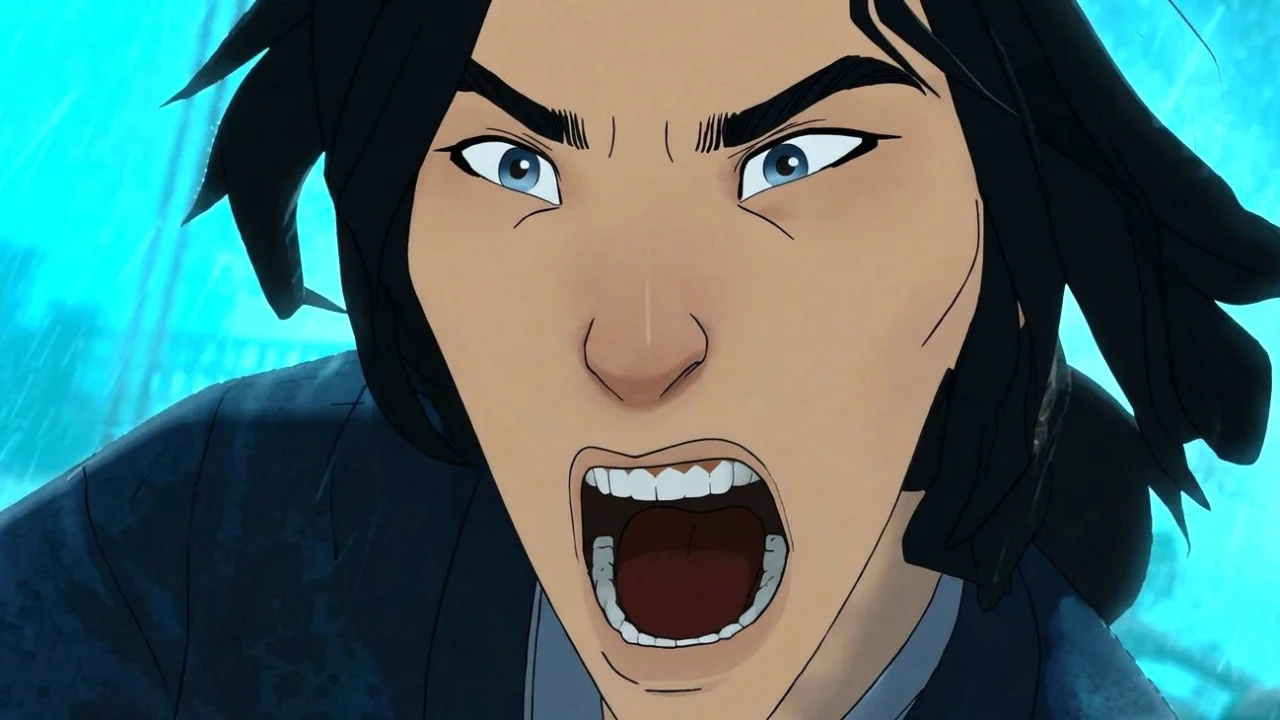
Mizu is taking her revenge mission overseas. Netflix has confirmed that Blue Eye Samurai Season 2 will premiere on January 19, 2027, with a new teaser sending the Emmy-winning animated series’ central warrior toward London. The second season will consist of six episodes, picking up where the first season left off as Mizu continues her search for the remaining men who could be her father.
The new footage offers another glimpse of the dangerous voyage ahead, with flashes of the sword fights waiting for Mizu on the other side. Her pursuit will bring her into unfamiliar territory, where the blue-eyed warrior will have to contend with a society very different from the one she left behind in Japan.
Netflix’s official description confirms that the London storyline is only part of the season. Back in Japan, Akemi and Taigen will be navigating Edo Castle under a dangerous new Shogun, while Ringo searches for a new purpose. Abijah Fowler, still in Mizu’s custody as she heads overseas, is also part of the continuing story.
Maya Erskine returns as the voice of Mizu, with Brenda Song back as Akemi, Darren Barnet as Taigen, and Masi Oka as Ringo. Season 2 also adds Jonathan Pryce as Old Violet, Joel Kim Booster as Priest Ando, and Sherry Cola as Kuma. Amber Noizumi and Michael Green return as creators, writers, and executive producers, with Jane Wu continuing as supervising director and producer. Blue Spirit is once again handling the animation.
The January 19 premiere means viewers will have waited more than three years since Blue Eye Samurai debuted on Netflix on November 3, 2023. That is a substantial gap for a series that made such a strong impression with its first season, but the wait has also given the creative team time to build an entirely new setting for Mizu’s next chapter.
When Blue Eye Samurai arrived, it introduced a revenge story set in 17th-century Japan, following Mizu, a mixed-race master of the sword who disguises herself as a man while hunting the four white men who were in Japan around the time of her birth. One of them may be her father. Her journey brought her into the lives of Ringo, Taigen, and Akemi, creating a story that mixed brutal sword fights with questions of identity, prejudice, power, and survival.
The series was created by husband-and-wife team Amber Noizumi and Michael Green, whose original idea had been developing for years before it reached the screen. Netflix’s production combined 2D and 3D animation, drawing on Japanese art and Bunraku puppetry for its character designs. The result gave the show a distinctive look, while its elaborate action sequences helped it stand apart from more familiar animated adventures. Netflix has specifically described the series as something other than anime, despite its Japanese setting and the creators’ appreciation for the medium.
The response to Season 1 was reflected in its awards haul. Blue Eye Samurai won the Primetime Creative Arts Emmy for Outstanding Animated Program, along with three additional juried Emmy awards recognizing character design, production design, and storyboarding. It also won all six awards for which it was nominated at the 51st Annie Awards, including Best Mature TV/Media, writing, editing, character animation, animated effects, and production design. The series also took home the ACE Eddie Award for Best Edited Animated Series.
That recognition helped establish Blue Eye Samurai as one of Netflix’s most acclaimed adult animated productions. Its popularity also gave Noizumi and Green the opportunity to continue the story they had mapped out from the beginning. Netflix has already renewed the series for a third season, which is planned as its final chapter in 2028.
Season 2 will now move Mizu’s story beyond Japan, placing her in London in 1657. The creators have described the city as a place where she will face a different kind of prejudice, confronting what it means to stand out as Asian in a largely white society while also navigating the restrictions placed on women during the period. It is a major change of setting for a series that spent its first season immersing viewers in Edo-period Japan, and the January premiere will finally show how that next stage of Mizu’s revenge unfolds.