
I enjoyed parts of How to Rob a Bank. But the plot derails midway through, as it tries to turn a bunch of bank robbing influencers into the good guys without earning the audience’s empathy. The 1985 Scottish heist flick Restless Natives did it way better. You should go watch that instead.
Even though you’ve probably never heard of it.
David Leitch’s new action-comedy How to Rob a Bank, starring John C. Reilly and Nicholas Hoult, wants us to believe that a bunch of thieves can become YouTube sensations by filming their crimes and convincing the internet that they’re a modern day version of Robin Hood and his Merry Men.
The movie pretends to understand online creators without really knowing how they make their content. It has a hard time convincing us that these gun-swinging bandits are the heroes. No matter how hard it tries, there’s never a moment of runtime where I’m rooting for the Wolf Pack.
If you read my review, you already know where I stand.
I had a problem with the movie’s Point Break obsession. Kathryn Bigelow’s surf-hiest-thriller has become the go-to bible for Hollywood screenwriters wanting to make an action movie with mask wearing criminals.
There’s a much better film about furry-coded outlaws that deserves your attention. It also features motorcycle getaways and accidental celebrity. It came out in 1985, way before Point Break. It’s from Scotland. And it’s called Restless Natives.
See. I knew you hadn’t seen it.
Now, listen. I’m not suggesting David Leitch watched Restless Natives and decided he could do it better. He’s discussed the real-world influences behind How to Rob a Bank, including extreme-sports creators and MrBeast’s brand of viral philanthropy.
But, seriously. For me? It’s hard to watch How to Rob a Bank and Restless Natives without seeing some remarkably similar ideas. Both feature masked criminals who avoid killing people, both featuring wolf mask. They all become folk heroes, turning their respective robberies into a public spectacle. They even have motorcycle escapes and determined investigators trying to catch them.
The difference is that Restless Natives doesn’t need a room full of monitors. There is no YouTube editing suite. It never relies on Hollywood-sized action sequences to make things work. It has two guys, a moped, a couple of joke-shop masks, and a very good idea.
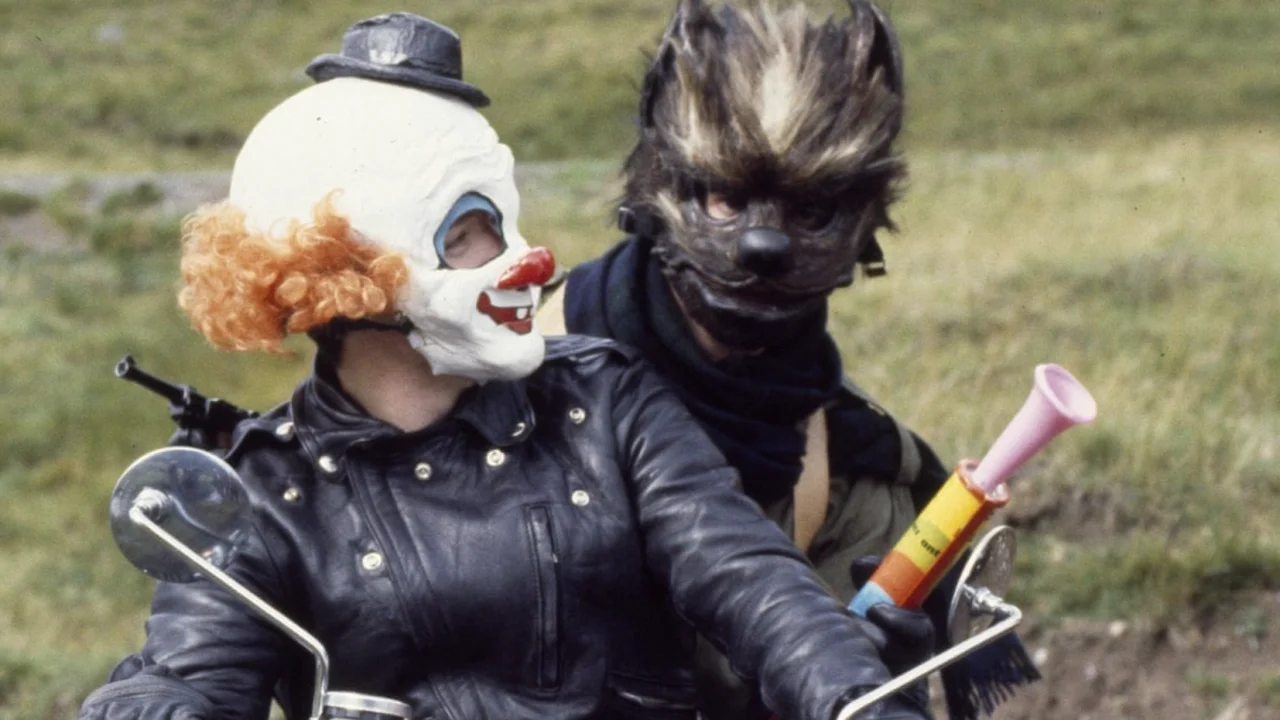
Directed by Michael Hoffman and written by Ninian Dunnett, Restless Natives follows Will (Vincent Friell), a road sweeper, and Ronnie (Joe Mullaney), who works in a joke shop. They’re young, broke, bored, and stuck in jobs that aren’t exactly taking them anywhere. Rather than accept that this is how life is going to be, the pair come up with a rather unusual business plan. They head into the Scottish Highlands, put on a wolf and clown mask, then begin holding up tour buses filled with American visitors.
Their weapons are toy guns, water pistols, and novelty gags, including sneezing powder. They’re not exactly the most terrifying criminals to ever hit the road. But Will and Ronnie aren’t trying to become hardened gangsters. They’re modern-day highwaymen. Taking money and valuables from wealthy tourists while trying to avoid hurting anybody.
Before long, their exploits turn them into local celebrities. The two friends become folk heroes. And the robberies themselves start attracting tourists who want to catch a glimpse of the masked outlaws.
That’s the part that makes Restless Natives such a natural companion to How to Rob a Bank. Both movies understand the appeal of turning criminals into celebrities. The difference is that Will and Ronnie become legends through word of mouth and the sheer novelty of two idiots riding around Scotland robbing tour buses. Nobody needs to explain the algorithm to them.
Their newfound fame attracts unwanted attention. Chief Inspector Baird (Robert Urquhart) is determined to stop the pair, while one of their victims turns out to be an American CIA agent named Bender (Ned Beatty). That’s a pretty unfortunate passenger to have on one of your robbery runs. The supporting cast also includes Bernard Hill and Mel Smith, giving this little Scottish adventure some familiar faces for anyone who grew up watching British film and television.
But the real star of Restless Natives might be its soundtrack. Scottish rock band Big Country provided the music. It gives the film an atmosphere that feels inseparable from its landscape. The score helps turn the Highlands into something almost mythical. While the band’s sound gives Will and Ronnie’s little rebellion a sense of adventure that a much bigger Hollywood production could spend millions trying to manufacture. If you’re familiar with Big Country, you’ll understand why this is such a wonderful fit.
There’s also something interesting happening beneath all the comedy. Restless Natives came out in the middle of a difficult period for Scotland. With unemployment and resentment toward the political climate of Margaret Thatcher’s Britain hanging over the country. Will and Ronnie aren’t sophisticated political revolutionaries. They’re two working-class guys who have had enough of their circumstances and decide to do something about it. Their targets are tourists. But the film’s Robin Hood spirit gives their antics a little more meaning than simple robbery.
Restless Natives didn’t get the kind of reception that might have helped it find a much bigger audience. It was loved in Scotland, but savaged by sections of the English press when it first arrived in 1985. Producer Andy Paterson later recalled how damaging those reviews were, saying the response nearly drove the filmmakers out of the industry. One critic called it “dreadfully unfunny,” while another dismissed it as “just tiresome.”
The film eventually made its way to American theaters in 1986. But it never became the widely discovered cult favorite it might have been. Without the kind of distribution push that turns a small movie into a rental-store staple, Restless Natives remained an elusive title for many American movie fans. It would take later rediscovery and restored releases for more people to get another chance to see what Scotland had been enjoying all along.
And that’s a shame. Restless Natives has exactly the sort of personality that makes an older movie worth tracking down. It’s whimsical without being precious. Rebellious without taking itself too seriously. The movie is full of the oddball charm that can get lost when a studio tries to turn every idea into a franchise-ready action spectacle.
Will and Ronnie aren’t trying to save the world. They just want to escape their miserable jobs and have a little fun. Somehow they wind up becoming the most popular criminals in Scotland.
Before you waste two hours watching How to Rob a Bank pretend that its YouTube videos were made by actual YouTubers, give Restless Natives a chance. You’ll get the masked outlaws, the motorcycle getaways, the Robin Hood antics, and a much better excuse to spend some time in the Scottish Highlands. You’ll also get Big Country on the soundtrack. That’s a pretty good deal all by itself.
Maybe Hollywood should spend less time trying to reinvent Point Break and more time watching the movies that already figured out how to have fun with a good idea.