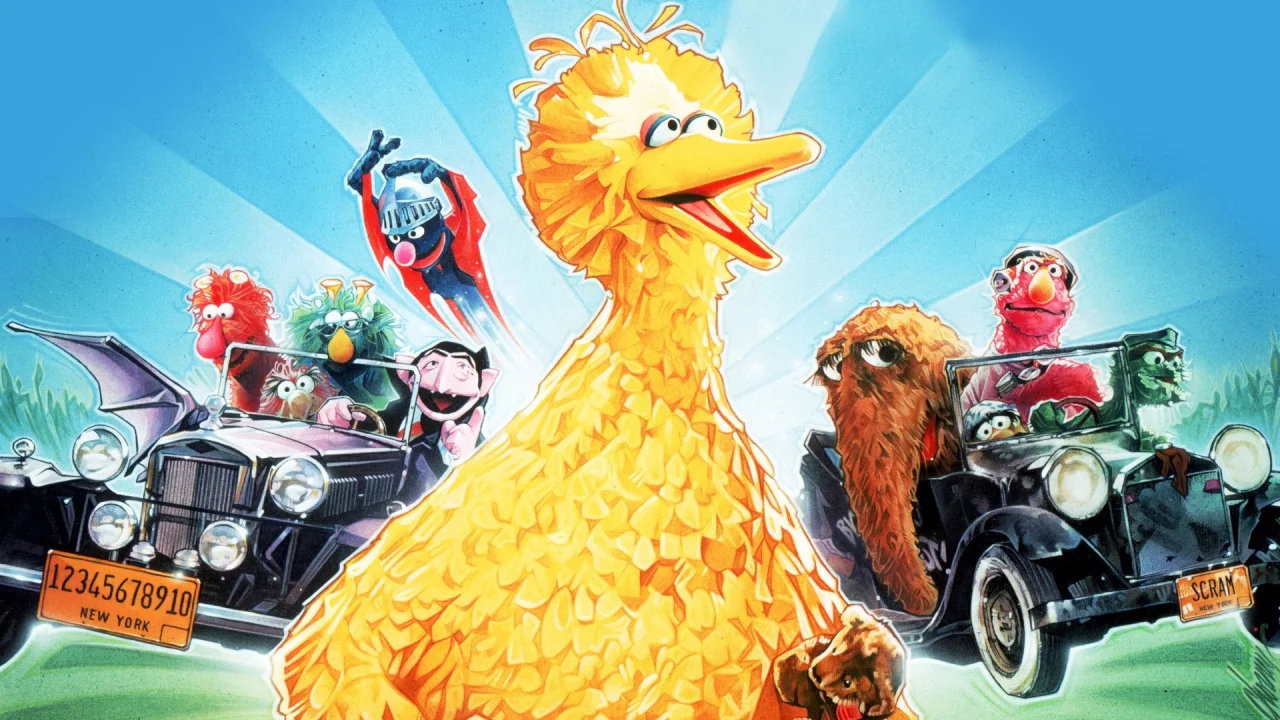
It’s November 10, which means it’s officially Sesame Street Day! For 57 years, that wonderful neighborhood has welcomed generations of children with a little help from Big Bird, Oscar the Grouch, Cookie Monster, Bert, Ernie and the rest of the gang. I could spend all day celebrating the show, but I have a particular movie in mind for the occasion. So, let’s find Big Bird and watch Sesame Street Presents: Follow That Bird.
First, a little history. Sesame Street made its television debut on November 10, 1969, created by Joan Ganz Cooney and Lloyd Morrisett through the Children’s Television Workshop, the organization that eventually became Sesame Workshop. Cooney wanted to use television to help young children develop skills they might otherwise have had to wait until school to learn. The result was a groundbreaking program that brought educational research into children’s entertainment, teaching letters and numbers while also helping young viewers understand the world around them. It was the first preschool program to combine education and entertainment with a multicultural cast.
The date became official in New York City in 2009, when the city proclaimed November 10 Sesame Street Day to mark the show’s 40th anniversary. The celebration included a temporary street sign near Sesame Workshop’s headquarters. Today, the program’s influence stretches far beyond its original New York neighborhood, with Sesame Workshop reporting that its programming reaches children in 190 countries. That’s a pretty impressive commute for a street that never seems to move.
But rather than just rewatching old episodes, I’m making the case for the first Sesame Street theatrical feature: Follow That Bird, released on August 2, 1985. Directed by Ken Kwapis in his feature-film debut, this musical road comedy took the familiar characters out of their neighborhood and sent them on a cross-country mission. It’s also a movie that deserves more love than its original box-office performance suggested.
The story begins when Miss Finch, a social worker representing an organization called the Feathered Friends, decides that Big Bird should be living with other birds. Apparently, his happy home on Sesame Street isn’t good enough because it contains humans, monsters and Grouches. Miss Finch arranges for him to move to Oceanview, Illinois, where he joins the Dodo family. Unfortunately, his new relatives aren’t exactly the welcoming family he hoped to find.
Big Bird becomes homesick and eventually decides to walk all the way back to Manhattan. Once news of his disappearance spreads, his Sesame Street friends set out to find him. They aren’t the only ones looking, though. The Sleaze Brothers, a pair of crooked carnival operators, realize they could make money by turning the enormous yellow bird into a sideshow attraction. Their plan involves painting Big Bird blue and presenting him as the Bluebird of Happiness. It’s a pretty rotten thing to do to a bird who just wants to go home.
Along the way, Big Bird encounters some memorable characters, including a friendly truck driver played by country music legend Waylon Jennings. The movie also features John Candy as a state trooper, Chevy Chase as a GNN news anchor, Sandra Bernhard as a Grouch restaurant waitress and Joe Flaherty and Dave Thomas as the Sleaze Brothers. Jim Henson and Frank Oz are on hand performing some of their most beloved characters, too.
The production has some wonderful behind-the-scenes stories. During Ernie and Bert’s performance of “Upside Down World,” Henson and Oz actually operated their puppets inside an upside-down biplane suspended about 18 feet off the ground. That’s a rather unusual day at the office, even by Muppet standards.
The farm scenes have their own bit of movie magic. After the original footage was damaged by scratches in the film stock, the crew had to return to the location months later. Unfortunately, it was winter. To make the scenes look like summer, the production spray-painted leaves green, while the children on set had to bundle up between takes. Oscar the Grouch also needed a little help looking properly grouchy. His new trash can looked much too clean, so the crew banged it up and dirtied it to give it the familiar battered appearance.
There’s another important piece of Sesame Street history connected to the movie. For 14 years, Mr. Snuffleupagus had been Big Bird’s best friend, but the adults on the street always seemed to miss him. They assumed Big Bird had invented his enormous, shaggy pal. Follow That Bird gave Snuffy a place in the story as Big Bird’s friend, and the character’s separation from the adults was becoming an increasingly awkward part of the show’s storytelling.
On November 18, 1985, just a few months after the movie’s theatrical release, Sesame Street finally ended the running gag. In Season 17’s premiere, Big Bird manages to get the adults to stay put long enough to meet Snuffy. Bob is the first to spot him, calling out, “Gordon! Judy! Look!” The adults finally understand that Big Bird had been telling the truth all along.
There was a serious reason behind the decision. Sesame Workshop explains that, following several high-profile child-abuse cases, the show’s producers wanted children to understand that the adults who cared for them would believe them when they shared something important. The Los Angeles Times reported the same concern when the episode premiered. It was a significant change for the series, and a reminder that Sesame Street could tackle difficult subjects without losing its warmth.
Of course, Follow That Bird has its own message about belonging. Miss Finch believes Big Bird should be with his own kind, but the movie makes a pretty convincing argument that family isn’t determined by what you look like. Big Bird already has a home with people who love him. The film’s story about prejudice and acceptance is one reason it still has something to say beyond its catchy songs and celebrity appearances.
The movie opened on August 2, 1985, the same weekend as Weird Science and Fright Night. It brought in roughly $14 million during its theatrical run, a disappointing result for the first big-screen adventure from such a beloved television institution. Its reputation grew through home video, where VHS copies helped introduce Big Bird’s road trip to generations of kids who weren’t around for its original release. Today, it remains a favorite for plenty of Muppet and Sesame Street fans.
If you want to keep the big-screen Sesame Street celebration going after Follow That Bird, there’s also The Adventures of Elmo in Grouchland, the second theatrical feature, released in 1999. Directed by Gary Halvorson, it puts Elmo in the spotlight as he ventures into Grouchland to retrieve his beloved blue blanket. The movie arrived during the late-’90s Elmo craze, but I’ll be honest: I’m not quite as eager to revisit that one. Big Bird’s cross-country adventure is the movie I’m putting on today. Happy Sesame Street Day!