
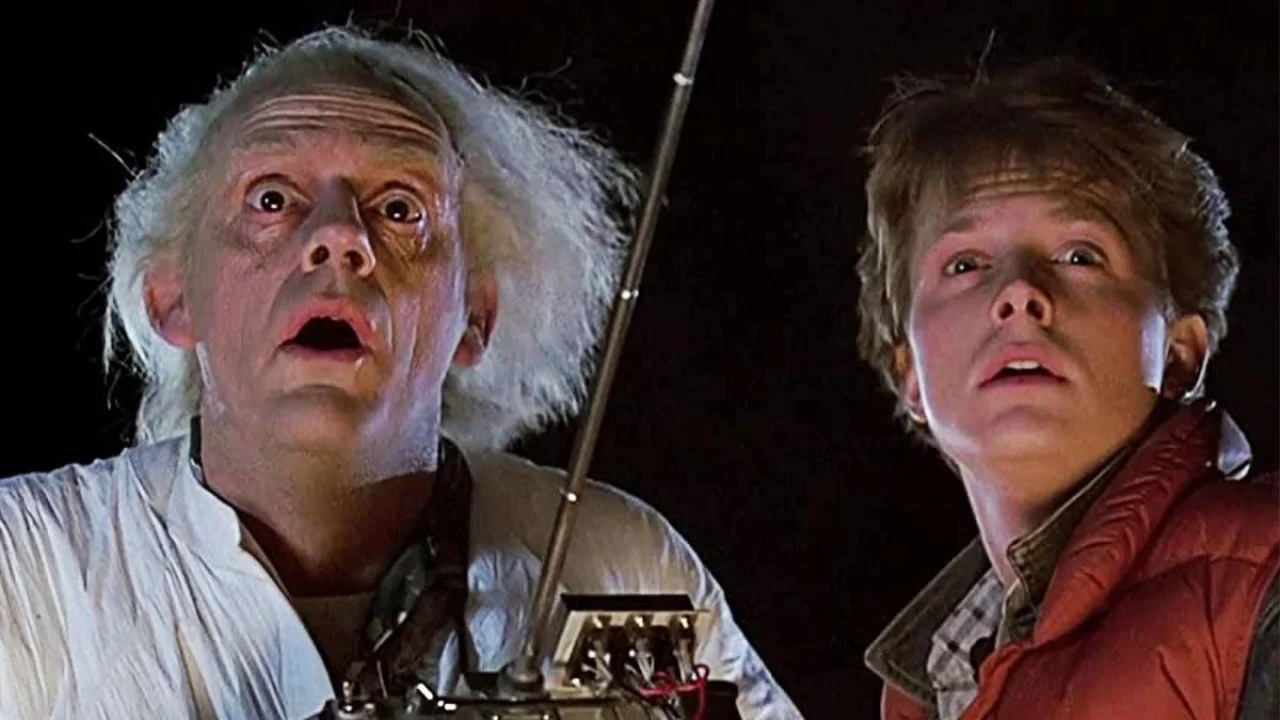
October 21 is Back to the Future Day, the perfect excuse to revisit one of the strangest ideas that almost made it into Robert Zemeckis’ beloved 1985 sci-fi adventure. Before Doc Brown built his time machine into a stainless steel DeLorean, he had something considerably less glamorous, and far more dangerous (at least for kids wanting to play along) in mind.
A refrigerator.
I learned this for myself back in the day, when I excitedly got my hands on a Back to the Future script in 1986. I was shocked by how different the movie could have been. There were some pretty big changes between the screenplay I read and the film audiences eventually got to see, but the refrigerator time machine and the original ending involving a nuclear test site were two of the most shocking surprises.
The DeLorean is so deeply connected to Back to the Future now that imagining the movie without it feels almost impossible. Marty McFly’s journey through time depends on that car, from its gull-wing doors to the requirement that it reach 88 miles per hour. But in the earlier screenplay drafts written by Zemeckis and Bob Gale, Doc Brown’s invention was a time chamber housed inside a refrigerator.
The idea was that Marty would climb inside the refrigerator to travel through time. Unlike the DeLorean, however, this machine couldn’t simply drive away once it reached its destination. The refrigerator stayed in one place, meaning Doc had to transport it whenever he needed to use it somewhere else. That led to a rather unusual plan for getting Marty back home.
The original ending took the characters to a nuclear test site in Nevada, where they hoped to harness the energy of an atomic bomb explosion. Doc and Marty would bring the refrigerator time machine to the site on the back of a truck, with Marty needing to get into position as the countdown to the test approached. Instead of the clock tower sequence that became one of the movie’s most memorable moments, the original story would have ended with an atomic blast.
That is a pretty spectacular difference for a movie that eventually made a lightning strike the centerpiece of its finale. The nuclear test sequence was also a major production challenge. Building a test-site town and filming the sequence would have cost a considerable amount of money, and the filmmakers ultimately dropped the idea. Zemeckis also realized that making the time machine mobile would make the story easier to film.
There was another concern with the refrigerator, and this one involved the audience. Steven Spielberg and the filmmakers worried that children might copy what they saw in the movie by climbing into old refrigerators and shutting themselves inside. Older refrigerators could have latches that made it difficult to escape, creating a genuine safety risk. A movie intended for younger audiences didn’t need to inspire kids to turn an abandoned appliance into a potential death trap.
The DeLorean solved both the storytelling and practical problems. Doc could build his invention into a vehicle that moved under its own power, and its unusual shape made it look like something that had arrived from another world when Marty took it back to 1955. The car also gave the filmmakers a way to make speed part of the time-travel mechanism, helping establish the rules that would carry through the sequels.
The abandoned refrigerator idea has an amusing afterlife, too. Steven Spielberg later directed Indiana Jones and the Kingdom of the Crystal Skull, which features Indiana Jones surviving a nuclear explosion by climbing inside a lead-lined refrigerator. That movie arrived in 2008, decades after the original Back to the Future screenplay explored a refrigerator in connection with an atomic blast. It’s hard not to think of the earlier script when watching Indy emerge from the wreckage.
The refrigerator time machine also eventually found its way into the franchise’s expanded comic book stories, including IDW’s Biff to the Future, which was co-written by Gale.
Looking back at the script I read in 1986, the most fascinating thing isn’t simply that Doc Brown almost used a refrigerator instead of a DeLorean. It’s how much the finished movie benefited from the changes. The nuclear test site might have delivered a spectacular climax, but the clock tower gave Marty a race against time that was much more personal and suspenseful. And while a refrigerator could have worked as a time machine, it would never have become the pop culture icon that Doc’s DeLorean is today.
Great Scott. Imagine trying to get that refrigerator up to 88 miles per hour. We would have had a totally different Back to the Future. And it probably wouldn’t be the classic, flawless masterpiece that we’re all celebrating today. Think about it. There probably wouldn’t even be a Back to the Future day.