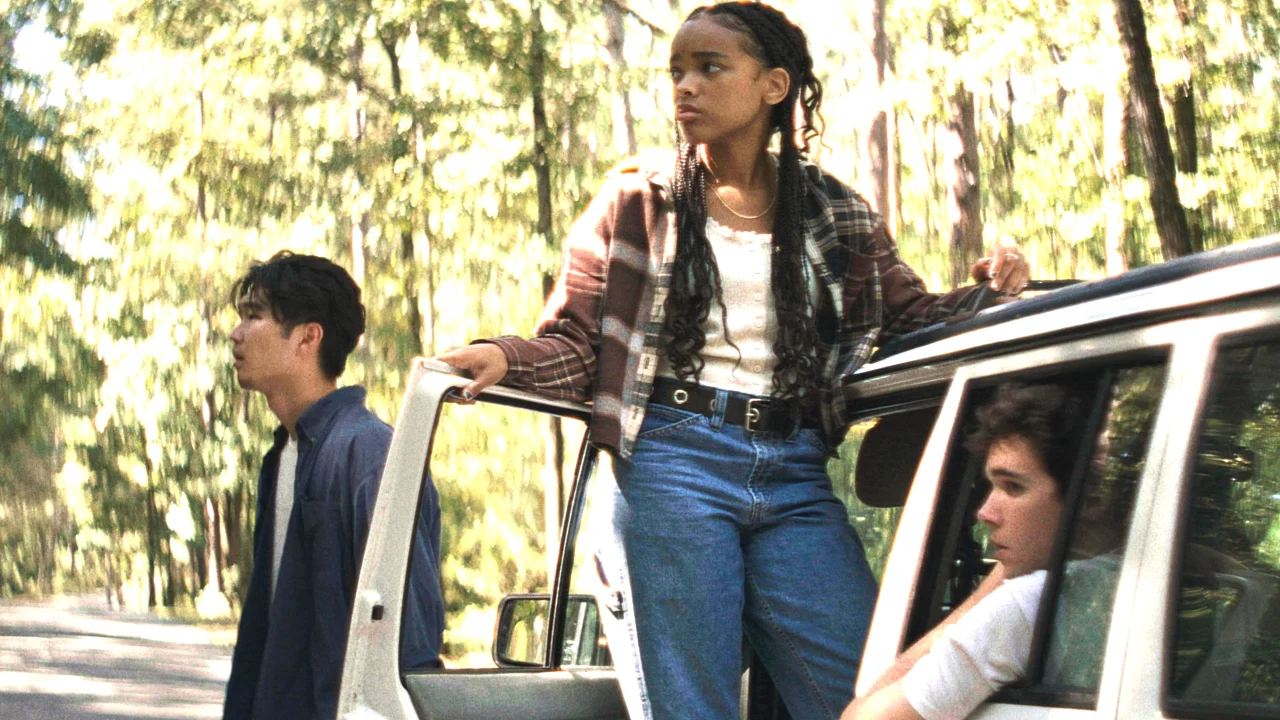
Jean-Paul Sartre once locked three individuals in a room and made them discover that hell is other people. Alexander Ullom took a different approach in It Ends. He put four recent college graduates inside a Jeep Cherokee and took away the option of going home.
The comparison to Sartre’s 1944 play No Exit is an easy one to make. Both stories trap people in a situation they cannot escape. Leaving them with little choice but to confront one another and whatever uncomfortable truths come bubbling to the surface. In It Ends, the characters aren’t waiting for a door to open. They’re waiting for a road to finally lead somewhere. The disappointment comes in learning that life is endless. Until it’s not. You just, splat…Fall on your face and that’s that.
There is one important detail that changes how we should look at this comparison between the two works, though. Which a lot of critics have clearly missed: Ullom wasn’t thinking about Sartre when he made It Ends . He’s not Curry Barker admitting that he watched The Simpsons Treehouse of Horror or The Twilight Zone before making Obsession. It’s quite the opposite.
In a September report from Variety, Ullom explained that he didn’t even know what No Exit was at the time he was making It Ends. He hadn’t read it, nor was he sitting around, thinking about twisting and changing the play into something for today’s generational youth.
“I didn’t even know what [No Exit] was at the time [of making the movie], but I’m more than grateful that anyone is comparing it to anything,” Ullom said.
That admission doesn’t make the comparison less interesting. If anything, it makes it more revealing. The Sartre connection is something viewers have brought to the film themselves. Not a reference Ullom planted for film students to discover. He wasn’t setting out to remake a famous existentialist play with a Jeep Cherokee. He was working through his own ideas about being young while facing the uncertain future that is our current reality. Finding yourself stuck somewhere between the life you’ve left behind and the one you’re supposed to start living is the true nightmare resting at the heart of this masterstroke of art. And it’s clearly on the road to becoming a cult classic in its own right.
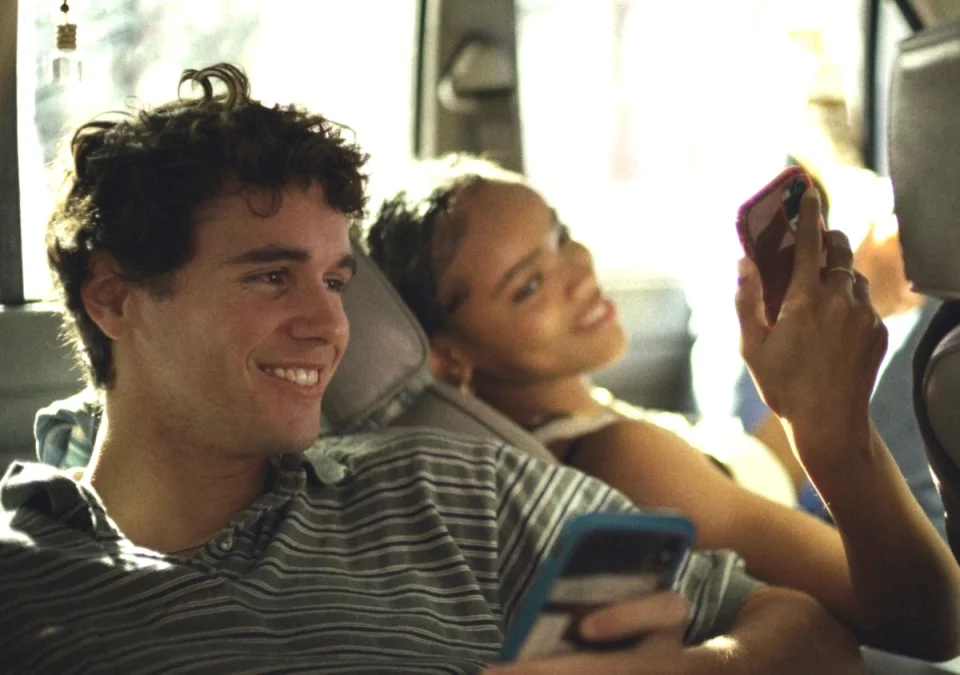
That’s the particular discomfort at the center of It Ends. Four friends have recently graduated from college, and the next stage of adulthood is waiting for them. Except the road doesn’t seem to be going anywhere. As the forest stretches around them and the journey continues without a destination, the usual expectations of a road trip fall away. The Jeep becomes a confined space where time and the promise of a future all start to feel questionable.
The characters have each other, but companionship isn’t necessarily a solution when nobody knows what’s happening. Their disagreements and shifting relationships become part of the experience. The road is frightening. But so is the realization that getting out of college doesn’t automatically mean knowing what comes next. Or that you’ll be able to withstand the non-changing flux of what was once a beautiful friendship. College roommates are like Pringles. Leave the cap off the tube, that shit will go stale.
Ullom’s film also has a rather remarkable story behind the camera. It Ends began with the kind of budget that makes independent filmmakers start looking around the room to see what they can borrow. The initial production budget was around $30,000, though Ullom later put the completed film’s budget at approximately $150,000. That is still a remarkably lean amount for a feature built around a road that appears to go on forever.
The filmmakers found an unusual way to make the Jeep scenes work. The interior driving sequences were filmed at Florida State University’s virtual production facility, where the vehicle was taken apart so it could fit inside the studio. The team could then control the background and lighting to create the illusion of the road outside, including the particular look of an endless blue-hour drive.
It was a practical solution to a production problem that could have become expensive very quickly. Rather than trying to film every interior scene inside a moving vehicle, Ullom and his crew built a controlled environment around the car. The woods and exterior material were filmed outside, so the virtual production setup wasn’t responsible for creating the entire world of the movie. It was a carefully chosen tool for the scenes that needed it.
The finished film was also a long time coming. Ullom began principal photography in 2022, with additional filming and reshoots taking place in 2023 and 2024. He has described the process as a six-year journey. With a substantial portion of the final movie coming together during those later shoots. For an independent production, that is a lot of time spent trying to get the road to end in the right place.
Then came the challenge of getting people to actually see it.
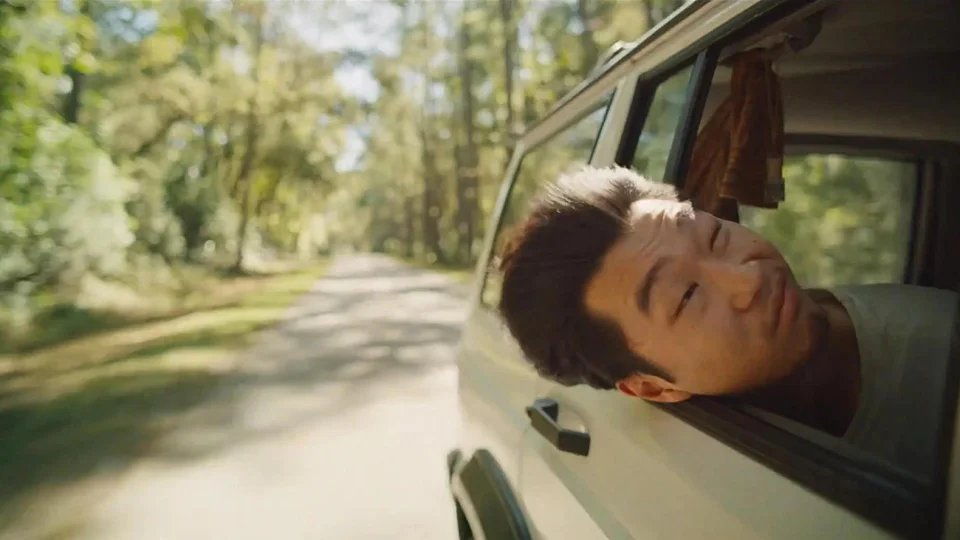
It Ends premiered at SXSW in March 2025. But a festival premiere doesn’t automatically translate into a distribution deal. The film spent time looking for its parking spot in the marketplace before finding an unexpected opportunity through Letterboxd’s Video Store. Its appearance in the platform’s Unreleased Gems program helped introduce the movie to a larger community of film fans. The response gave it new momentum.
NEON acquired the film for theatrical distribution days after its Letterboxd Video Store debut. It eventually reached U.S. theaters on August 21, 2026. That’s a pretty good outcome for a movie that started with a tiny production budget and spent a considerable amount of time trying to find an audience.
There is something fitting about that journey. It Ends is a movie about people who don’t know where they’re going, and its own route to theaters was hardly a straight line. The film found its audience through people talking about it, recommending it, and making connections that weren’t necessarily part of the filmmaker’s original plan.
That includes the Sartre comparison. Ullom may not have known No Exit existed while he was making the film. But viewers recognized something familiar in the experience of being trapped with other people and unable to move forward. The play and the movie arrive at that uncomfortable territory from very different directions. One locks its characters in a room. The other puts them in a Jeep and keeps the scenery moving.
Maybe the more interesting question isn’t whether It Ends is a modern No Exit. Ullom has already answered the question of influence. It’s why so many viewers arrived at that comparison on their own. A film about the anxiety of having no clear destination can apparently take people to some pretty philosophical places. Even when its director never intended to make that particular stop.